
LIVE WEBINAR SERIES:
Best Practices for Mixed-Language FPGA Design and Verification (EU)
Alex Gnusin, ALINT-PRO Product Manager, Aldec
Thursday, January 22, 2026
4:00 PM - 5:00 PM (CET)
|

Abstract:
As modern FPGA projects continue to integrate IP developed in multiple HDLs, effective mixed-language design and verification has become essential for maintaining productivity, reuse, and verification completeness. While mixed-language flows are widely supported, both implementation tools and simulators can impose restrictions that must be clearly understood to avoid costly surprises late in the design cycle.
- The role of mixed-language development in modern FPGA designs
- Challenges and motivations for combining VHDL and Verilog
- Overview of tools and simulation environments
- Mixed-Language Design Rules and Implementation Restrictions
- Avoiding common pitfalls during synthesis and implementation with ALINT-PRO
- Mixed-Language Verification Strategies
- Demonstration: FIFO Design Examples
- Example 1: FIFO in Verilog with VHDL testbench
- Example 2: FIFO in VHDL with a directed Verilog testbench
- Example 3: FIFO in VHDL with a randomized Verilog testbench
- Efficiency Comparison and Best-Practice Recommendations
- Q&A
Presenter Bio:
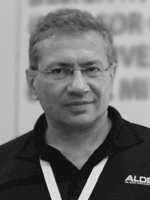
Alex Gnusin,
Aldec’s ALINT-PRO Product Manager
Alex accumulated 28 years of hands-on experience in various aspects of ASIC and FPGA design and verification. In a previous role and as Verification Prime on a multi-million gates project, Alex combined various verification methods including static linting, formal property checking, dynamic simulation and hardware-assisted acceleration to efficiently achieve design verification goals. Alex has an M.S. in Electronics, awarded from Technion, Israel Institute of Technology, and his former employers include IBM, Nortel, Ericsson and Synopsys.


